


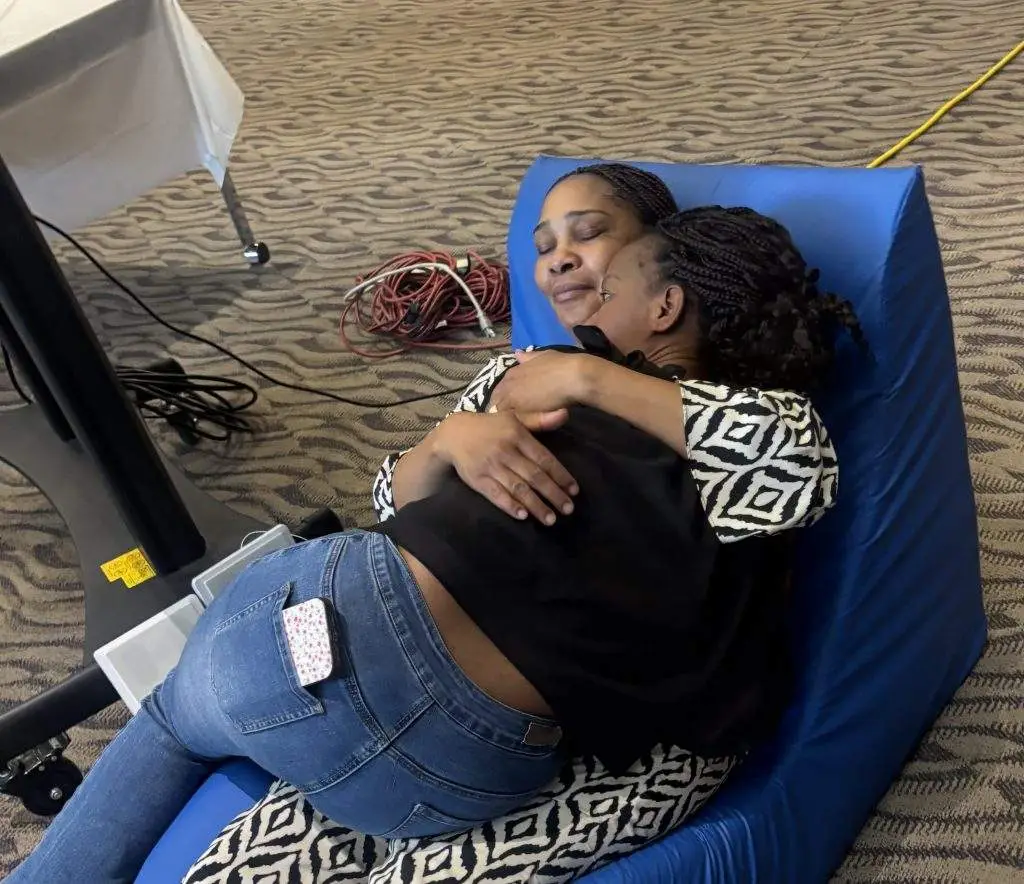
This month, I had the chance to introduce something new to several of our Efshar partner schools: a vibroacoustic chair.
At first glance, it looks like a comfortable chair. But once you sit down, something remarkable happens. Sound becomes something you don’t just hear-you can feel it.
The chair uses vibration to translate sound and music into a full-body sensory experience. For young children, that can open up entirely new ways to explore music, regulation, and learning.
For me, this project has been eight years in the making.
A Journey That Started in Israel
Eight years ago, I visited the Beit Issie Shapiro Institute in Ra’anana, Israel, as part of an educator trip. I was introduced to their innovative work using sound vibrations to help children who are deaf or hard of hearing experience music.
I was fascinated.
The idea that a child could experience music through their body, not just through their ears, stayed with me. I kept thinking about what this technology could mean for early childhood classrooms and for children with a wide range of sensory and developmental needs.
Years later, that idea became an opportunity for Efshar. Together with the Efshar team, we secured funding through the Staenberg Anything Grants™, funded by the Staenberg Family Foundation and administered by JEWISHcolorado, to bring a vibroacoustic chair and compatible speakers into our network of Jewish early childhood programs. The vision was not simply to purchase a piece of equipment, but to create a shared resource that could travel from school to school, paired with professional learning and coaching.
And now, we’re beginning to see what that vision can look like in practice.
What Happens When Children Can Feel the Music?
During this year’s professional development sessions, educators had the opportunity to experience the chair themselves before brainstorming ways to use it with children. We also had a few children in the room and their reactions were some of the best evidence of the chair’s potential.
One infant settled comfortably while listening to a recorded heartbeat.
A toddler laughed with delight as she felt the Bluey theme song vibrating through the chair.
Educators began imagining all kinds of possibilities. One teacher suggested pairing the vibrations with a video of a Jerusalem shuk, creating a multisensory experience that could allow children to see, hear, and physically feel a place they were learning about.
Others immediately recognized the chair as a potential tool for helping children who are anxious or overwhelmed. The vibrations provide proprioceptive input, which can help some children feel more grounded and regulated.
And that is one of the things I find most exciting about this project: the chair isn’t a solution for one particular child or one particular need.
It can be a calming space for a child who needs a moment to regulate. It can be an avenue for a child who is deaf or hard of hearing to experience music. It can become part of a lesson about Israel, a transition between parts of the day, or simply a joyful way for a child to experience a favorite song in an entirely new way.
The educators are already imagining possibilities I hadn’t considered.
In fact, after seeing the chair in action and hearing the teachers’ feedback, one school director offered to purchase an additional chair for her school.
That kind of response tells me we’re onto something.
A Resource Designed to Be Shared
One of the most important pieces of this project is that the chair doesn’t belong to just one classroom.
Efshar’s model allows us to bring the chair to different schools throughout our network, giving educators the opportunity to experiment with it, learn from one another, and receive hands-on coaching.
Over the coming months, I plan to continue visiting schools with the chair, modeling ways to incorporate it into classroom experiences, and working alongside educators to observe what works best for their children.
We’ll explore questions like:
- How can vibroacoustic technology support children’s regulation and transitions?
- How can we intentionally incorporate vibration into multisensory learning?
- How can the chair support children with different sensory needs?
- How might it deepen children’s experience of music, movement, and Jewish learning?
- What strategies can educators take from this experience and apply even without the chair?
We’ll also gather feedback and observations from educators and school leaders so we can better understand the impact and document what we’re learning.
The goal isn’t simply to introduce a new piece of technology. It’s to expand the toolbox educators have for creating inclusive, responsive, sensory-rich classrooms.
Help Us Bring This Resource to More Children
We are incredibly grateful that the Staenberg Anything Grants™ provided 50% of the funding for this project. Their support made it possible to turn an idea I’ve carried with me for years into a resource that is now being experienced by children and educators across the Efshar network.
The grant was designed to help launch this one-time, tangible investment in innovative sensory tools for Jewish early childhood programs, and it is already creating opportunities for multiple schools to benefit from the equipment.
Now, we’re looking for partners to help us fund the remaining 50%.
That investment will allow us to continue expanding access to vibroacoustic learning, support additional equipment where there is demonstrated interest, and build on what we’re learning as the chair moves through our network.
Eight years ago, I saw a child experience music through vibration in Israel and wondered what might be possible in our own early childhood classrooms.
Today, I’m watching our educators and children begin to answer that question.
And we’re just getting started.
Want to see the vibroacoustic chair in action? Watch my three-minute introduction to the technology and the story behind the project:
Watch Josh explain the vibroacoustic chair
Interested in helping us fund the remaining 50% of this project? We would love to connect with you.


